
Achieve perfect wavy hair by understanding hair density and face shape—the keys to a flattering, low-maintenance style.
The morning mirror had become Ethan’s battleground. Every day, his dense waves greeted him with a new kind of chaos—frizz on humid afternoons, flyaways when the wind picked up, and a stubborn flatness at the crown that refused to cooperate. He’d scroll past red‑carpet photos of Timothée Chalamet’s “organized chaos” curls and wonder, How hard can it be? But watching a stylist craft those textured layers on screen never quite translated to his own fingers. So, at thirty‑four, Ethan decided it was time to stop guessing and start understanding what truly makes a wavy hairstyle work.
His first stop was a consultation with Samantha, a Los‑Angeles‑based stylist who’d shaped the manes of more than a few nominees. She didn’t even glance at the inspiration photos on his phone before asking, “Do you know the density of your hair?” Ethan blinked. Density? He’d never considered how many strands per square inch he was working with. Samantha explained that a stylist must read the shape and density first—just as Mark, a New York stylist, would later confirm. “The technique changes completely based on how thick the hair lies,” Mark said. “A man with loose, fine waves can’t expect the same cut as someone with tight curls.” Ethan learned that a blended, less dense layering means an easier grow‑out and a more forgiving silhouette. For the first time, he felt like a collaborator instead of a passenger.
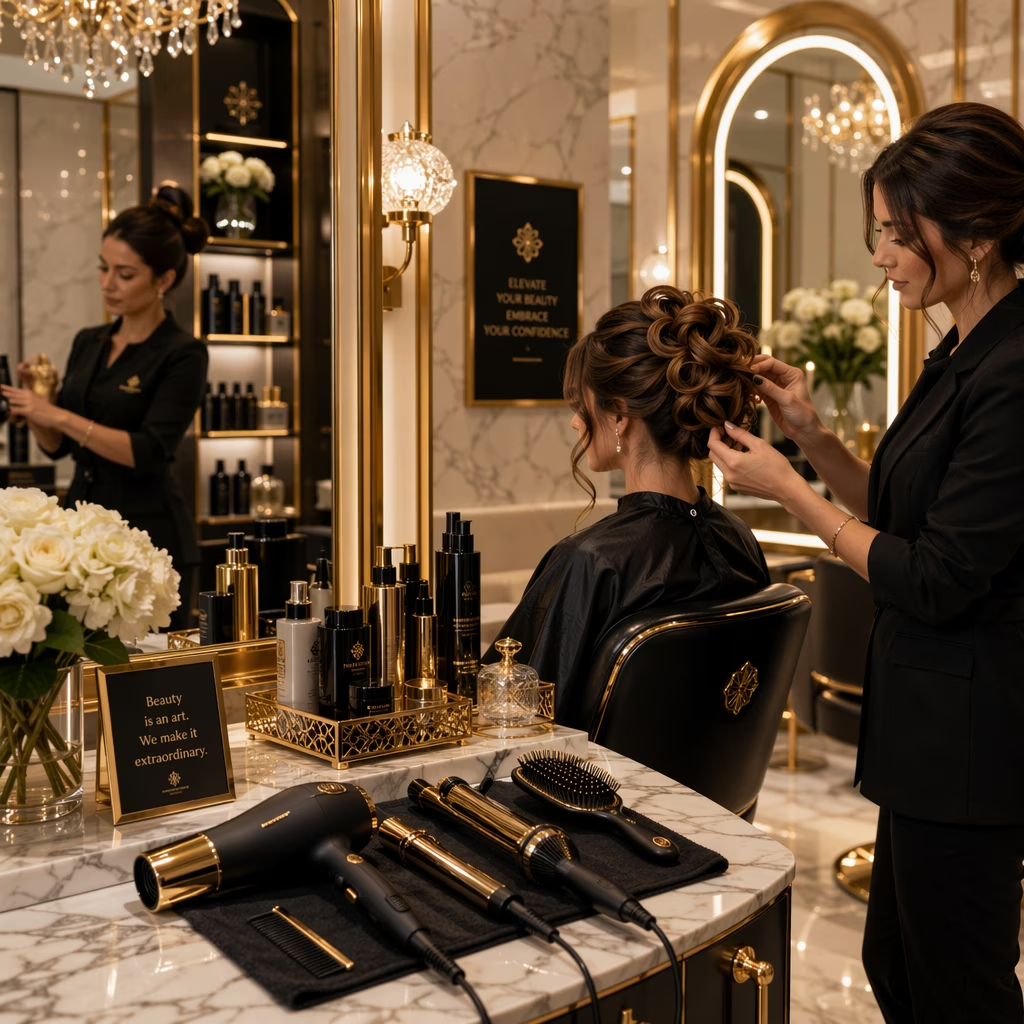
With the cut decided—a modern shag graduated at the crown to avoid flattening—came the styling lesson. Samantha handed him a diffuser and set his blow‑dryer to cool. “Air‑drying is your friend, but if you’re in a rush, diffuse gently. Then comb the waves back, spray close to the roots, and finally push them into place. You’re sculpting, not battling.” She recommended a curl cream for definition and an oil for ends that needed moisture. That evening, Ethan tried the routine. His hair didn’t look like a Chalamet replica, but it had a depth he’d never seen before. Could everyday waves feel this deliberate? The answer was a quiet yes.
As spring turned to summer, Ethan began noticing how different men wore their texture. At a rooftop party, a friend sported a tight fade that graduated into glossy waves, reminiscent of the look Mark called “structured rebellion.” Another colleague rocked a grown‑out shag like Dev Patel, all scissors‑texturized layers that seemed to dry effortlessly. Ethan realized the real magic of wavy hair isn’t in copying a celebrity—it’s in finding the cut that honors your bone structure. Mark’s rule was simple: wavy hair suits any face, but the shape must complement the jaw and cheekbones. A high‑contrast fade could sharpen a round face; a fuller top could balance a long forehead.
The following month, Ethan spotted a man on the subway whose voluminous waves were sculpted into a debonair pomp—a look straight out of Taika Waititi’s playbook. He learned that hair wax and a texturizing cream could create that separation, keeping longer strands blown back while short sides held their own. A sea‑salt spray, he discovered, was the secret to the beachy bedhead models like Marlon Teixera wore; it added complexity and a touch of nonchalance. And for those mornings when his waves refused to align, a small curling iron or even a perm was an option Mark noted for looser textures chasing Jack Harlow’s rounded mop top.
But not every wavy style demanded high effort. Ethan’s gym buddy, a man with short, tight curls, kept his sides cropped and his top textured—a cut that required little more than a monthly trim and a good conditioner. Isn’t that the ultimate luxury? A style that looks intentional yet takes minutes to refresh. When Ethan finally grew his own length past the ears, he experimented with a half‑up knot like Jason Momoa, letting the rest cascade with the help of a humidity‑fighting curl cream. On a lazy Sunday, he tried a middle part with wavy bangs to soften his high forehead, and it worked.
Reflecting on his journey, Ethan understood that the best wavy hairstyle isn’t a static picture—it’s a conversation. Between you and your stylist, between your hair and the weather, between the products you choose and the time you’re willing to invest. A pomade could give you a glossy, directional finish like the one Odell Beckham Jr. paired with high‑buzzed sides. A texturizing spray could make a classic bowl cut, as worn by Dominic Fike, feel fresh and shaggy. Even a simple slick‑back, like Adam Brody’s, balanced by well‑groomed facial hair, could radiate ease.
By 2026, the conversation around men’s waves had shifted from Can I pull this off? to Which version of me do I want to meet today? Ethan’s bathroom shelf now held a few heroes: a lightweight oil for dry ends, a sea‑salt spray for casual days, and a cream with hold for structured evenings. He’d learned to diffuse on cool, to ask for graduated layers, and to trust that humidity isn’t a defeat but a chance to let his hair move differently. As he caught his reflection now, he didn’t see a battle. He saw someone who knew his own texture, and that, he thought, was the sharpest look of all.